
SEO Expert in Gurugram
Attract More Relevant Visitors and Generate Better Business Enquiries
Looking to attract more relevant visitors and generate better website enquiries? Prabhat Software helps businesses improve search visibility through technical SEO, keyword research,content optimization and practical SEO strategies.
- Higher Rankings
- Targeted Traffic
- Quality Leads
- Long-Term Growth

A Practical SEO approach for sustainable business growth
If your website isn’t attracting the right visitors from Google, publishing more articles or adding extra keywords may not fix the problem. You need to understand what is limiting your website’s search performance and which improvements can make a real difference.
An experienced SEO Expert in Gurugram can help you identify technical issues, improve key pages, understand search intent, and build a more focused organic search strategy.
At Prabhat Software, our SEO approach starts with understanding your website, business objectives, and current search performance. The aim is not simply to improve keyword positions. It is to help your website reach relevant audiences and create better opportunities for enquiries.
Whether you are launching a new website, facing a decline in organic traffic, or struggling to convert website visitors into customers, the right SEO strategy should begin with proper research and a clear action plan.
If you want to understand how SEO works before hiring a professional, read our Complete SEO Guide for Delhi Businesses 2026. It covers important SEO strategies, Google ranking factors, and practical optimization techniques to help you make informed decisions for your business.
How can an SEO Expert in Gurugram help your business?
A professional-looking website does not automatically attract customers from Google. Your website may have useful information and several service pages, yet important pages might remain difficult to find in search results.
Sometimes the problem is technical. In other cases, the website targets irrelevant keywords, lacks useful content, or does not guide visitors towards the next step.
An SEO expert investigates these issues instead of making random changes.
For example, consider a real estate consultancy serving businesses around Golf Course Road. It may need visibility for specific commercial property searches. A healthcare practice in Sector 56 may need its website to reach people searching for particular treatments or specialists.
Both businesses need a search strategy, but their target keywords, website content and customer journeys will be different.
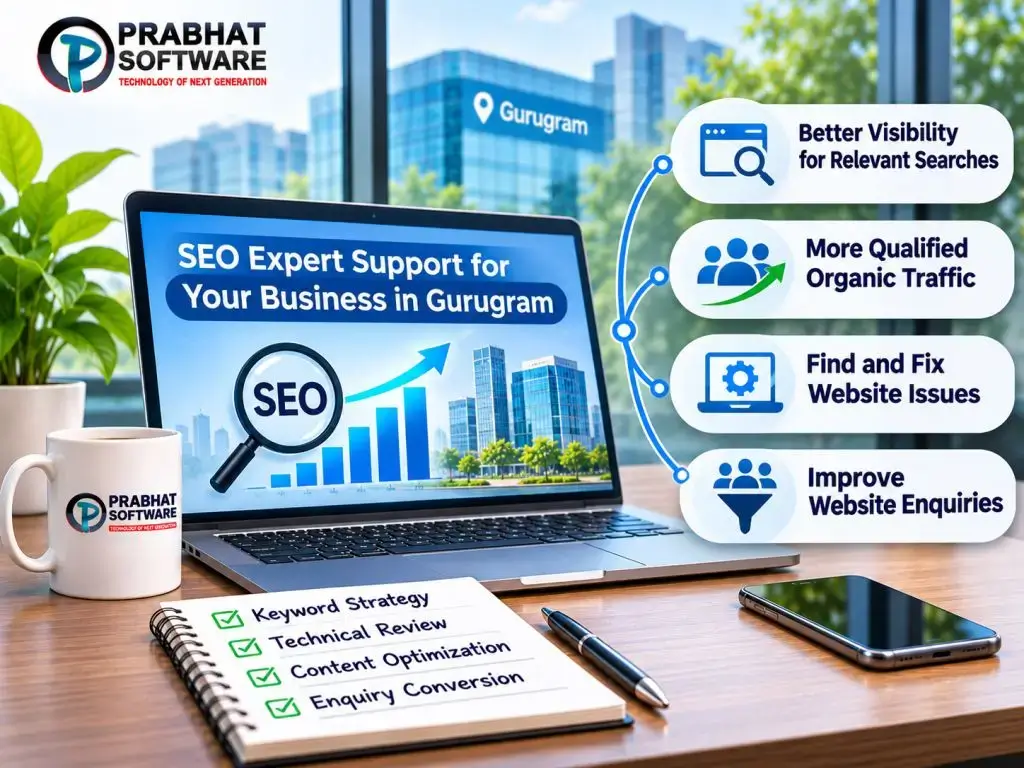
Improve Visibility for relevant search terms
Ranking for a keyword is useful only when it attracts the right audience.
An SEO strategy should distinguish between different types of searches:
- Informational: What should businesses know before investing in commercial property?
- Navigational Search Intent: Users want to find a specific website, business, company, consultant, or online resource related to commercial property in Gurugram.
- Commercial: Commercial property consultant in Gurugram.
- Transactional: Hire a commercial property consultant in Gurugram.
Each search reflects a different stage of the customer’s decision-making process.
A useful SEO strategy connects these searches with the right website pages instead of directing every visitor to a generic landing page.
Attract more qualified organic traffic
More traffic does not necessarily mean more business.
A website can receive thousands of visits while generating very few enquiries. This may happen when the content attracts people who are not looking for the services being offered.
The focus should be on attracting visitors whose requirements match your products or services.
This involves relevant keyword research, well-structured landing pages, useful content and a clear enquiry process.
Identify problems affecting website performance
Sometimes fixing an existing website problem is more useful than publishing another article.
An SEO review may identify:
- Important pages that are not indexed.
- Incorrect canonical tags.
- Broken internal links and redirect errors.
- Duplicate or overlapping content.
- Poor website architecture.
- Slow-loading pages.
- Weak mobile usability.
- Unclear page titles and descriptions.
- Pages targeting similar search intent unnecessarily.
The objective is to understand which issues affect important pages and prioritise the corrections.
Improve website enquiries
SEO should not stop when someone reaches your website.
Visitors should understand what your business offers, whether your service matches their requirements, and how they can contact you.
Clear service descriptions, useful information, visible contact options, and a simple enquiry process can help improve the experience for relevant visitors.
Rankings can bring people to your website, but the quality of the landing page and your offer also influence whether they contact you.
SEO helps build sustainable organic traffic over time, but combining it with other digital marketing strategies can deliver better overall results. Explore our Digital Marketing Complete Guide for 2026 to understand how different marketing channels work together to attract potential customers, generate leads, and support business growth.
What does a Professional SEO Expert actually do?
An SEO expert combines website analysis, keyword research, technical evaluation, content optimization, and performance monitoring.
The exact work depends on the website’s current condition and business objectives. A new website may need a stronger technical and content foundation. An established website may require a review of existing rankings, technical problems, or overlapping pages.
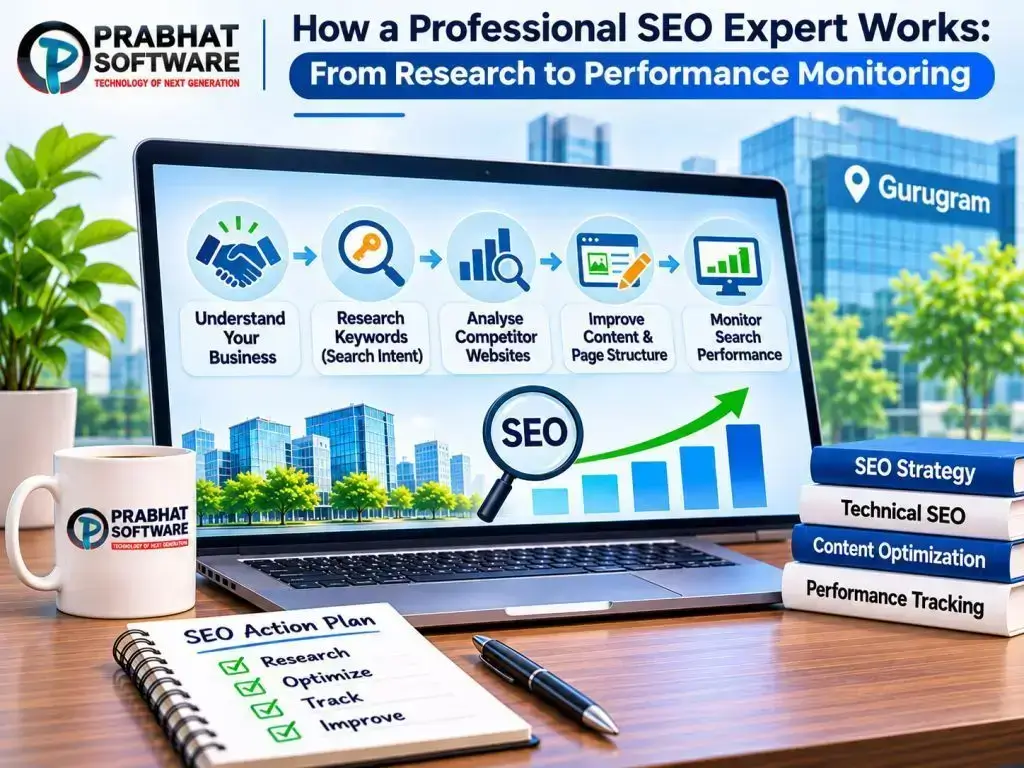
1. Understand your business and search requirements
Before selecting keywords, an SEO professional needs to understand your business.
This includes:
- Your main products and services.
- Target customers and audience requirements.
- Business objectives.
- Target locations and markets.
- Main competitors.
- Existing website structure.
- Current organic search performance.
This information helps determine which SEO activities are relevant to your business.
2. Research keywords based on search intent
Keyword research should consider more than search volume.
A keyword with high search volume may have little commercial value if the searcher is not looking for your service.
A professional SEO strategy considers:
- Primary and secondary keywords.
- Commercial and transactional searches.
- Informational search queries.
- Long-tail keywords.
- Problem-related searches.
- Customer questions.
- Competitor keyword coverage.
The objective is to assign relevant keywords to suitable pages.
For example, the search term “SEO Expert in Gurugram” has a different purpose from “What is technical SEO?” The first may indicate a person evaluating SEO professionals, while the second is more likely to reflect an informational requirement.
These searches should not automatically target the same page.
3. Analyse Competitor Websites
Competitor analysis helps identify how other websites address the same search market.
An SEO expert may examine:
- Landing page structure.
- Keyword targeting.
- Content quality and coverage.
- Internal linking.
- Technical website performance.
- Search visibility.
- Missing information and content gaps.
The purpose is not to copy competitors. It is to understand what users expect and identify opportunities to provide more useful information.
4. Improve website content and page structure
Each important page should have a clear purpose.
On-page optimization may involve improving headings, rewriting unclear descriptions, strengthening content, adding relevant internal links and removing unnecessary repetition.
For service businesses, different services should have clearly defined pages when they serve different search intents.
This helps visitors find relevant information and reduces unnecessary overlap between website pages.
5. Monitor search performance
SEO performance should be evaluated using more than a single keyword position.
Useful indicators include:
- Organic clicks and impressions.
- Search queries.
- Click-through rate (CTR).
- Average search position.
- Indexed pages.
- Organic landing-page performance.
- Website enquiries.
- Conversion activity, where tracking is available.
Google Search Console and website analytics can help evaluate these signals.
The important part is understanding what the data indicates and deciding what should happen next.
SEO Services in Gurugram: what your website may need
Every website has different requirements. Some need technical corrections, while others need better content, keyword targeting, or a more organised website structure.
The following SEO activities can form part of an engagement, depending on the agreed scope.
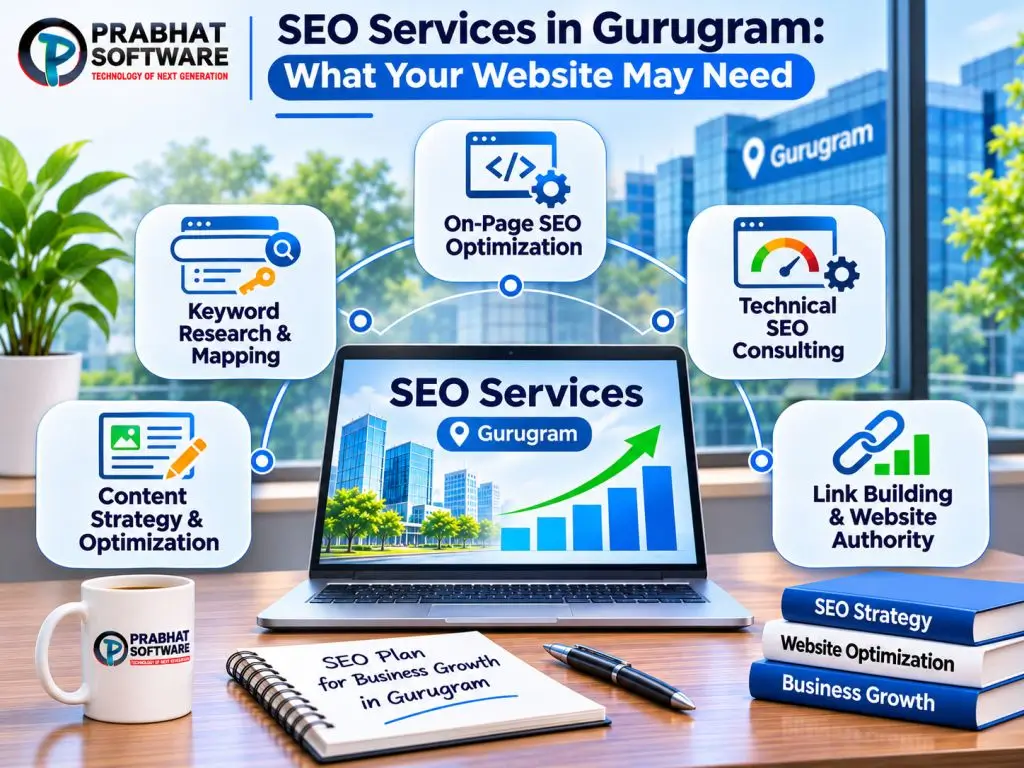
1. Keyword research and keyword mapping
We identify relevant search terms based on your business, products, services, customers, and competition.
Keyword mapping helps determine which page should target which search intent. It can also reduce the risk of creating multiple pages that compete for similar queries.
2. On-Page SEO optimization
On-page SEO improves how individual pages communicate their subject and purpose.
Depending on the website, this may include:
- SEO title and meta description recommendations.
- H1, H2, and H3 heading structure.
- Content relevance and completeness.
- Natural keyword placement.
- Image optimization and descriptive alt text.
- URL structure recommendations.
- Contextual internal linking.
- Search intent alignment.
The objective is to improve the usefulness and clarity of important pages, not simply increase keyword repetition.
The objective is to improve the usefulness and clarity of important pages, not simply increase keyword repetition.
3. Technical SEO consulting
Technical SEO consulting evaluates website-level issues that may affect crawling, indexing, rendering, and page experience.
A review may cover XML sitemaps, robots.txt, canonical tags, redirects, website architecture, mobile usability and performance.
The recommended corrections should come from actual website findings rather than applying an identical checklist to every website.
If Google has indexed your website but your pages are still struggling to rank, there may be underlying SEO issues affecting their visibility. Read our guide on Why Your Website Is Indexed but Not Ranking to understand the common causes and what you should check before making further SEO improvements.
4. Content strategy and optimization
A business website may need better service pages, supporting articles, comparison content or answers to common customer questions.
Content planning can include:
- Topic and keyword clustering.
- Search intent analysis.
- Content gap identification.
- Existing article improvements.
- New page recommendations.
- Heading and information architecture.
- Internal linking opportunities.
The focus should be on useful, original content rather than publishing large numbers of similar articles.
5. Link building and website authority
Relevant links and genuine business mentions can help search engines discover website pages and understand their relationships with other websites.
A responsible link-building approach should focus on relevance, editorial quality, and genuine value.
Avoid buying large volumes of unrelated backlinks or using automated link schemes. A high number of links does not automatically mean stronger search performance.
6. Local SEO and Google Maps Optimization
Businesses targeting customers in specific areas of Gurugram need more than general website optimization. Their website should clearly communicate the services they offer, the locations they serve and the value they provide to local customers.
We focus on improving location-specific website content, relevant local keywords, service page structure, internal linking and technical SEO. These improvements help search engines understand your business offerings and connect your website with relevant local search queries.
Website SEO and Google Business Profile optimization serve different but complementary purposes. If you need dedicated support with Google Business Profile management and Google Maps visibility, explore our GMB Expert in Gurugram services.
Understanding local ranking factors is equally important. Read our guide on how to rank your business on Google Maps in 2026 to learn about the factors that influence Google Maps visibility and the practical steps businesses can take to improve their local presence.
Technical SEO Expert in Gurugram: fix website-level problems
Some websites need more than basic content changes. Technical problems can affect how search engines access important pages and understand the relationship between different URLs.
A technical SEO expert should investigate these issues and explain their impact in practical terms.
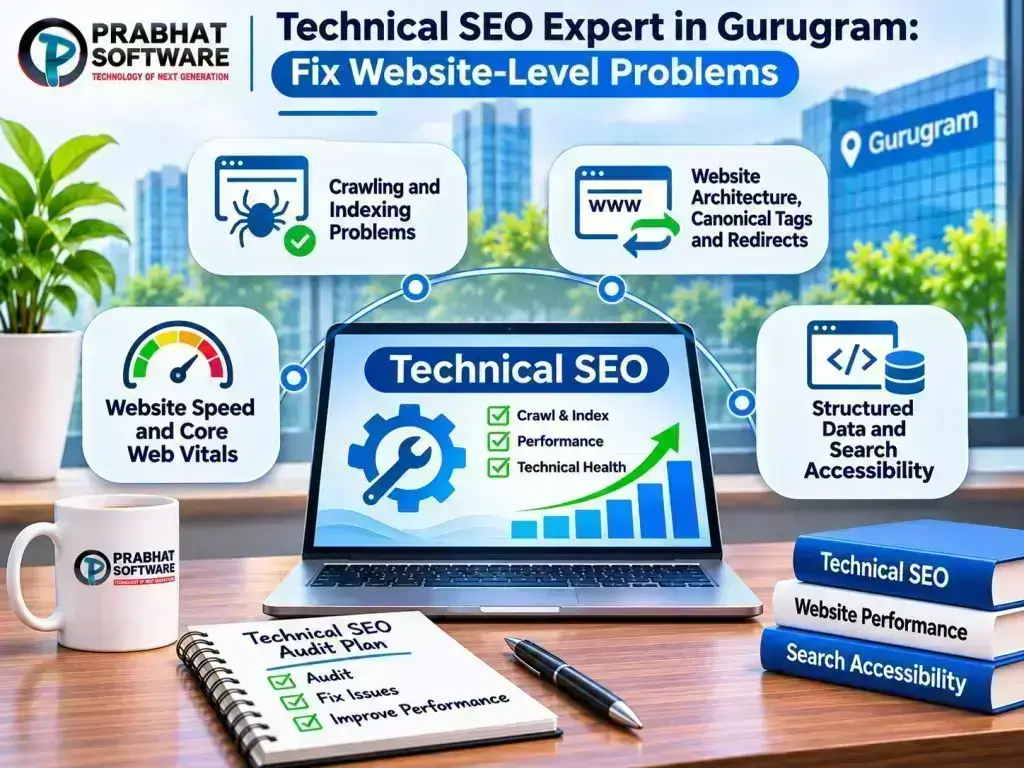
1. Crawling and indexing problems
Publishing a page does not guarantee that it will appear in Google Search.
Search engines need to discover and crawl a page, process its content and decide whether it should be included in their index.
A technical review may examine:
- Whether important pages can be accessed by search engines.
- Whether robots.txt blocks essential resources.
- Whether accidental noindex directives exist.
- Whether the XML sitemap contains appropriate URLs.
- Whether internal links support page discovery.
- Whether indexing issues affect individual pages or larger website sections.
The solution depends on the actual cause. Submitting a sitemap, for example, does not automatically resolve every indexing problem.
2. Website architecture, canonical tags and redirects
Websites with several similar pages can develop URL-related problems.
Examples include duplicate pages, incorrect canonical tags, unnecessary redirects, and overlapping landing pages.
An SEO specialist evaluates which URLs should remain accessible, how related pages should connect, and whether search engines receive consistent signals about the preferred page.
Keyword cannibalization also needs careful investigation. Two pages mentioning similar keywords do not automatically compete with each other. Their search intent, actual rankings, and query-to-page relationships should be examined before recommending consolidation or rewriting.
3. Website speed and core web vitals
Website performance affects how people experience your website.
Google’s Core Web Vitals measure loading performance, responsiveness and visual stability through three metrics:
- Largest Contentful Paint (LCP).
- Interaction to Next Paint (INP).
- Cumulative Layout Shift (CLS).
An SEO expert can evaluate these metrics alongside mobile usability, image sizes, JavaScript behaviour, and other performance issues.
A useful technical recommendation should identify the affected pages or templates and explain what may need to change. Simply saying that a website needs to be faster is not an actionable recommendation.
4. Structured data and search accessibility
Structured data helps search engines interpret specific information on a page.
Depending on the website, relevant schema types may include Organization, BreadcrumbList, Article, and appropriate service-related structured data.
The implementation must represent accurate information that is supported by the visible page content.
Adding unsupported ratings, fake reviews, or incorrect business details does not improve trust.
Our SEO Process: from website analysis to optimization
Good SEO work should follow a logical process. Making random title changes, publishing articles without research, or building links without understanding the website can waste time and resources.
At Prabhat Software, our proposed approach focuses on understanding the website first and prioritising improvements based on its requirements.
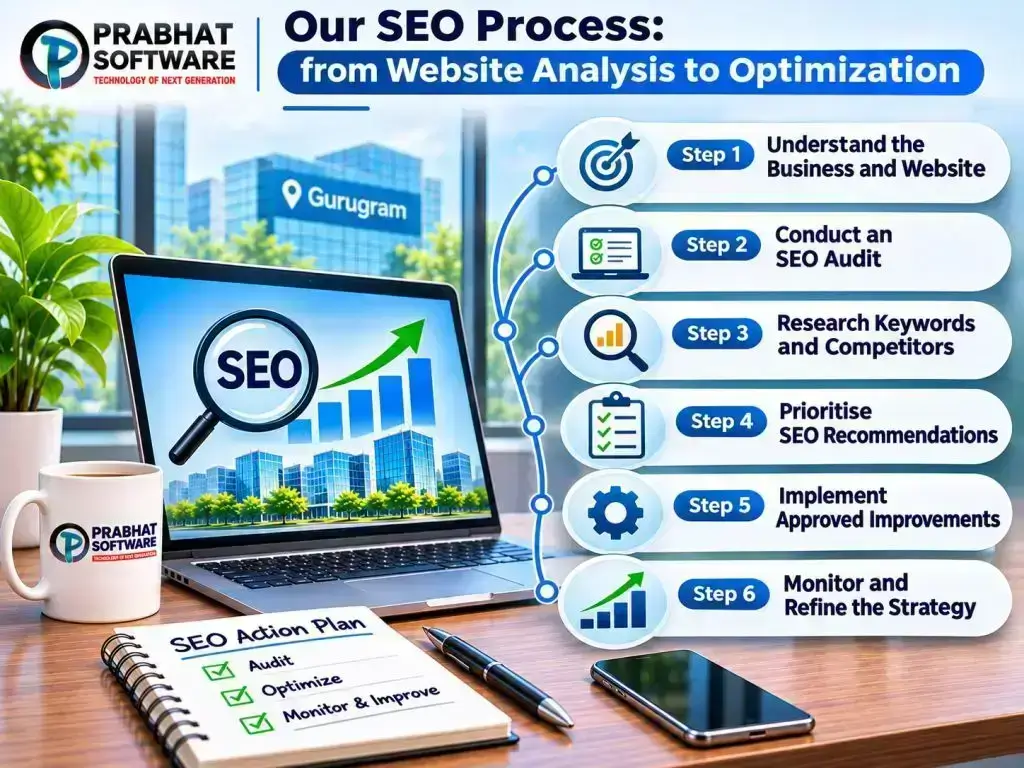
Step 1: Understand the business and website
We begin by understanding your business model, website, products or services, target audience, and objectives.
This establishes what the SEO work needs to address.
Step 2: Conduct an SEO audit
We review the website to identify relevant technical, content, on-page, and structural issues.
Where available, Google Search Console and analytics data can provide additional insight into existing organic performance.
Step 3: Research keywords and competitors
Relevant search terms are mapped to suitable pages.
Competitor analysis helps identify missing information, content opportunities, and areas where the website needs a stronger approach.
Step 4: Prioritise SEO recommendations
Not every recommendation should be implemented at once.
Suppose an audit identifies three issues:
An important service page is not indexed.
Several page titles do not clearly communicate their subject.
A blog image is missing alternative text.
The indexing issue may deserve attention first because the affected service page cannot appear in search results while it remains unavailable for indexing.
Prioritisation should consider business relevance, affected pages, implementation effort, and potential benefit.
Step 5: Implement approved improvements
Approved recommendations can be implemented according to the agreed project scope.
This may involve technical corrections, page optimization, content improvements, internal linking, and website structure changes.
Some changes may require developer involvement. Responsibilities should be confirmed before implementation.
Step 6: Monitor and refine the strategy
SEO performance should be reviewed periodically.
Search data helps identify which pages are improving, which queries are gaining visibility, and where further work may be required.
If an improvement does not produce the expected result, the next decision should come from further analysis rather than automatically repeating the same action.
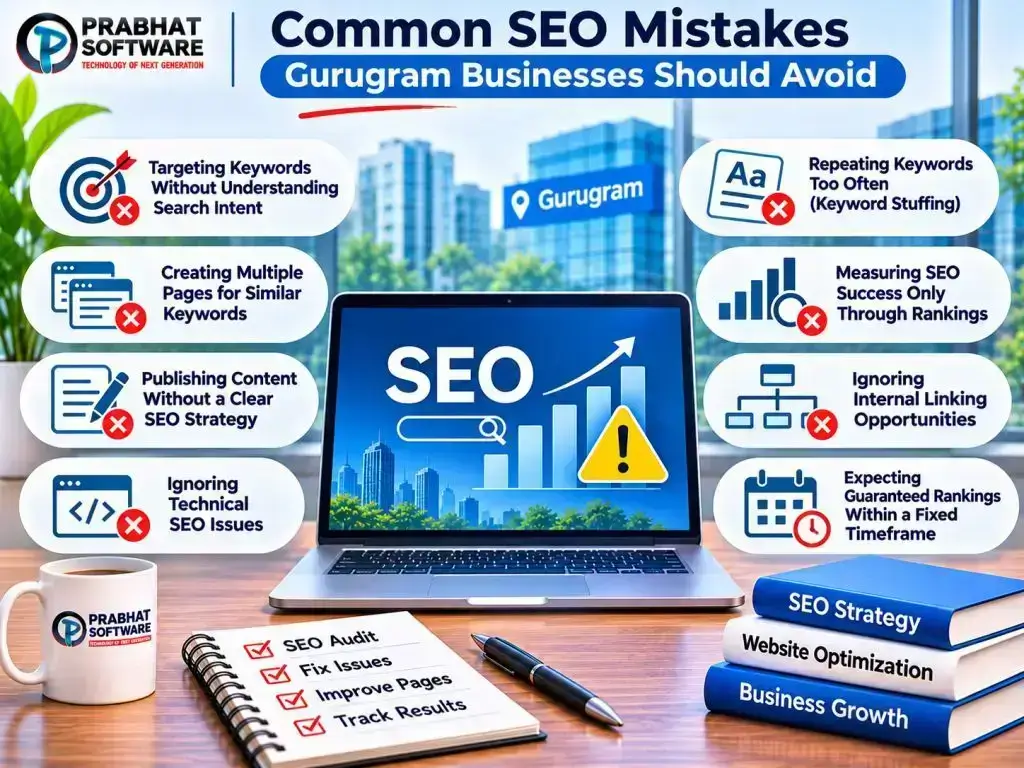
Common SEO mistakes Gurugram businesses should avoid
Many websites struggle with search performance not because they lack content, but because their SEO activities are not properly planned.
Here are some common mistakes worth checking before investing in more SEO work.
Important pages may remain poorly connected even when the website contains several related articles.
What to do: Add contextual internal links that help visitors discover relevant services and supporting information.
1. Targeting keywords without understanding search intent
Adding a high-volume keyword to a page does not guarantee relevant traffic.
A service page should target people looking for a service, while an educational article should answer informational questions.
What to do: Review the search results and understand what users expect before assigning a keyword to a page.
2. Creating multiple pages for similar keywords
Some businesses create separate pages for slightly different keyword variations without giving each page a distinct purpose.
This can create unnecessary overlap and make it harder to understand which page should rank.
What to do: Map keywords to existing pages first. Create a new page only when it serves a genuinely different search intent or user requirement.
3. Publishing content without a clear strategy
Publishing more articles does not automatically improve organic visibility.
A website may already have enough content but still lack strong service pages, useful internal links, or clear topic coverage.
What to do: Review existing pages, search performance, and content gaps before planning new articles.
4. Ignoring technical SEO issues
A website may have important pages that are blocked, incorrectly canonicalized, or difficult to discover.
Adding more content will not fix an underlying technical problem.
What to do: Check crawling, indexing, redirects, canonical tags, sitemap configuration, and website architecture.
5. Repeating keywords too often
Excessive keyword repetition makes content difficult to read and can weaken the overall quality of a page.
What to do: Use keywords naturally where they help explain the subject. Cover related questions and concepts without forcing exact-match phrases into every heading.
6. Measuring SEO success only through rankings
A keyword moving up in search results does not necessarily mean the business is receiving more qualified enquiries.
What to do: Review organic clicks, relevant queries, landing-page performance and enquiries alongside ranking data.
7. Ignoring internal links
Important pages may remain poorly connected even when the website contains several related articles.
What to do: Add contextual internal links that help visitors discover relevant services and supporting information.
8. Expecting guaranteed rankings in a fixed time
Search performance depends on competition, website condition, content quality, implementation, and search engine systems.
No SEO professional can control every ranking outcome.
What to do: Choose a professional who explains the work, sets realistic expectations, and reports progress transparently.
SEO readiness checklist for your business website
Before hiring an SEO expert or starting a new SEO engagement, it helps to understand your website’s current condition.
This checklist covers important areas that may need attention. You do not need every item to be perfect before starting SEO. Use it to identify possible gaps and discuss priorities with your SEO professional.
Website and technical health
- Important website pages are accessible.
- Important pages are eligible for indexing.
- XML sitemap is configured correctly.
- Robots.txt is not blocking important pages.
- Canonical tags point to the appropriate URLs.
- Broken links and unnecessary redirects have been reviewed.
- Mobile usability has been checked.
- Website performance and Core Web Vitals have been evaluated.
- Important structured data is accurate.
Keyword and content planning
- Primary and secondary keywords are identified.
- Search intent has been checked for target keywords.
- Keywords are mapped to relevant pages.
- Important service pages have clear purposes.
- Existing content has been reviewed before creating new pages.
- Similar pages have been checked for unnecessary overlap.
- Content answers relevant customer questions.
- Titles, descriptions, and headings are properly structured.
Website structure and user experience
- Important pages are easy to find.
- Internal links connect related content.
- Navigation is clear.
- Service descriptions explain what the business offers.
- Contact information is easy to find.
- Enquiry forms work correctly.
- Calls to action are clear and relevant.
SEO monitoring and reporting
- Google Search Console is configured.
- Website analytics is configured.
- Organic clicks and impressions are reviewed.
- Search queries and landing pages are monitored.
- Important conversions or enquiries are tracked where possible.
- SEO recommendations have clear priorities.
- Progress reports explain completed work and next steps.
How to use this checklist: You do not need every item to be perfect before starting SEO. Use it to identify gaps, understand your website’s current condition, and discuss priorities with your SEO professional.
What to expect when working with an SEO Expert in Gurugram?
Before hiring an SEO professional, understand what the engagement includes.
SEO deliverables vary according to the website, business requirements, and agreed scope. The following outputs can form part of an SEO engagement with Prabhat Software, subject to the final scope agreed with the customer.
1. Website SEO audit and findings
An SEO audit evaluates the website’s current condition and identifies areas that may require attention.
Depending on the engagement, the review may cover:
- Technical website issues.
- Crawling and indexing.
- Page-level optimization.
- Website architecture.
- Content relevance.
- Internal linking.
- Existing organic search performance.
A useful audit should explain the identified problems, affected pages and their potential importance.
Simply sharing a long automated tool report without explaining the findings does not provide enough information for informed decisions.
2. Keyword research and competitor analysis
Keyword research identifies relevant search terms and evaluates how they relate to your products, services, and target audience.
Competitor analysis helps explain how other websites address similar search requirements and where useful opportunities may exist.
Depending on the agreed scope, the work may include:
- Primary and secondary keyword research.
- Search intent classification.
- Keyword-to-page mapping.
- Competitor observations.
- Content gap identification.
- Recommendations for relevant landing pages.
The objective is to provide a clearer direction for website optimization and content planning.
3. Prioritized SEO roadmap
An SEO roadmap organizes recommendations into a practical sequence.
It should help you understand:
- Which website problems require attention.
- Which pages should be prioritized.
- What improvements are recommended.
- Which actions require development or content support.
- Which activities can be implemented independently.
- What should be reviewed after implementation.
This gives the business a clearer understanding of the proposed work instead of receiving an unorganized list of SEO suggestions.
4. Progress updates and performance reporting
SEO reporting should explain what changed and what those changes mean.
Depending on the agreed reporting arrangement, updates may include:
- Organic clicks and impressions.
- Click-through rate and average position.
- Important search queries.
- Organic landing-page performance.
- Completed optimization activities.
- Technical improvements.
- Enquiries and conversions, where tracking is configured.
The purpose of reporting is to support better decisions, not to present impressive-looking numbers without context.
SEO requirements of different businesses in Gurugram
Gurugram has a varied business environment, from technology companies and corporate service providers to healthcare practices, property businesses and retailers.
Each business category has different customers, search behaviour and website requirements. A suitable SEO approach should reflect these differences rather than applying the same keyword and content strategy to every website.
The following examples illustrate how SEO requirements can vary across industries. They are not claims about specific Prabhat Software client projects.
1. SEO for IT, SaaS and B2B Businesses
IT and SaaS businesses often need to explain technical products, business benefits and differences between competing solutions.
Their SEO requirements may include:
- Solution-focused keyword research.
- Product and service page optimization.
- Technical and educational content.
- Comparison and alternative pages.
- Clear product information.
- Business enquiry pathways.
For these businesses, the website should help potential customers understand what the solution does and how it relates to their requirements.
2. SEO for Real estate and property businesses
Property-related searches often depend on property type, location, buyer requirements and project information.
An SEO strategy may evaluate:
- Property category pages.
- Location-specific search requirements.
- Project and listing information.
- Commercial and residential property searches.
- Informational property guides.
- Internal linking between related property pages.
The challenge is to organize property information clearly without creating unnecessary pages for minor keyword variations.
3. SEO for Healthcare and Professional Services
Healthcare practices and professional firms need clear, trustworthy and accurate information.
Their websites may require:
- Service-specific landing pages.
- Accurate professional information.
- Clear appointment or enquiry processes.
- Answers to common customer questions.
- Appropriate local search information.
- Relevant internal links.
Content accuracy and appropriate professional review are particularly important for subjects that can affect people’s health or financial decisions.
4. SEO for Retail and E-commerce Businesses
Retail and e-commerce websites may contain hundreds or thousands of product and category URLs.
Their SEO requirements can include:
- Product and category page optimization.
- Product information improvements.
- Category architecture.
- Internal linking.
- Duplicate URL management.
- Indexing evaluation.
- Product page content optimization.
The right priorities depend on website size, platform, product range and existing organic search performance.
Why consider Prabhat Software for SEO Expertise in Gurugram?
Choosing an SEO professional is an important business decision. You need someone who can understand your website, explain the proposed work and provide recommendations that make sense for your business requirements.
Prabhat Software works across website development, software development and digital marketing, including SEO.
This combination of business capabilities provides relevant context when evaluating how website structure, technical implementation and search optimization fit together.
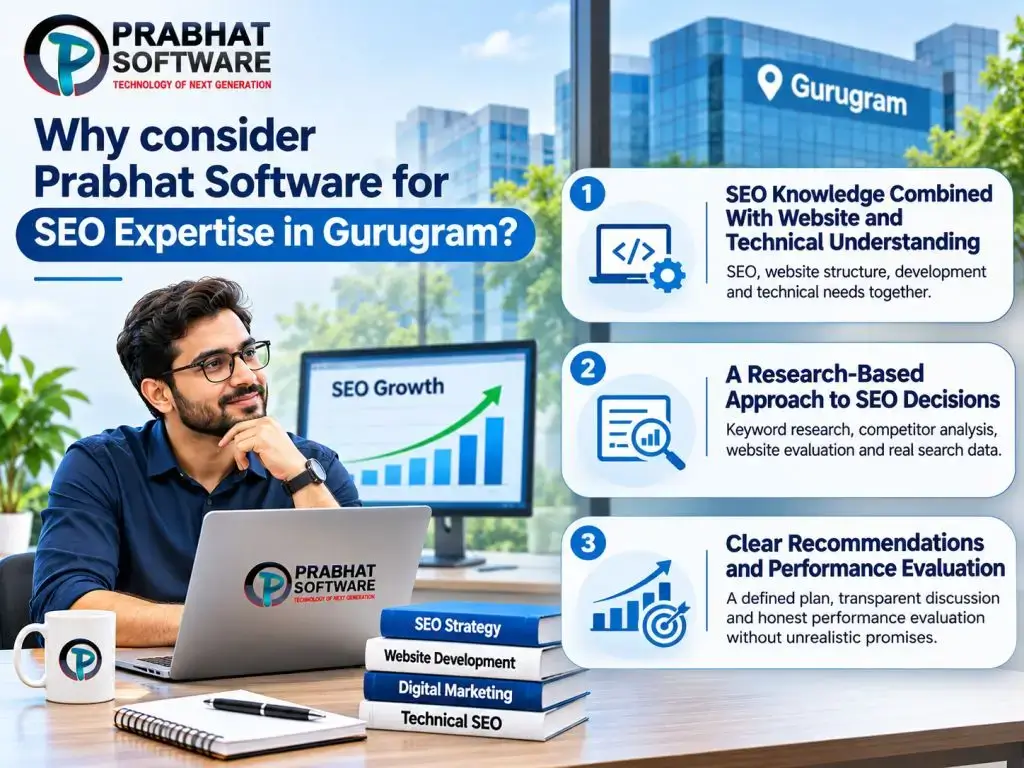
1. SEO knowledge combined with website and technical understanding
SEO recommendations sometimes involve more than changing website content.
A technical problem may require a developer. A website structure issue may need changes to navigation or URL organization. A content problem may require a different approach to page structure and search intent.
Prabhat Software’s published business capabilities include website and software development alongside digital marketing. This makes website-related and technical requirements relevant areas to discuss when defining an SEO engagement.
2. A Research-based approach to SEO decisions
A useful SEO recommendation should have a clear reason behind it.
Keyword research, competitor analysis, website evaluation and search performance data help establish where improvements may be needed.
Rather than treating every website in the same way, the proposed work should reflect its current condition, search requirements and business objectives.
This helps prioritize relevant improvements instead of making random changes based only on keyword positions.
3. Clear recommendations and performance evaluation
You should understand what work is being considered, why it matters and what is included in the agreed engagement.
Prabhat Software can discuss the proposed analysis, recommendations, roadmap and reporting requirements before the work begins.
No responsible SEO professional can guarantee a particular Google ranking or promise that every optimization will produce a specific result.
Search visibility depends on several factors, including competition, website condition, search intent, implementation and Google’s systems.
The objective should be to make informed improvements, communicate progress clearly and evaluate performance honestly.
How to hire the Best SEO Expert in Gurugram
Hiring an SEO expert should involve more than comparing prices or accepting a promise of first-page rankings.
A few practical checks can help you make a better decision.
1. Understand your website's current SEO requirements
Before approaching an expert, identify the main concern.
Is your website struggling to get indexed? Has organic traffic declined? Are important service pages not ranking? Does the website attract visitors but generate very few enquiries?
You do not need to diagnose the problem yourself. A clear description of what you have observed will help the professional understand your requirements.
2. Evaluate technical and strategic knowledge
Ask how the expert investigates website problems.
A knowledgeable professional should be able to explain technical findings, keyword decisions, content recommendations, and the reasoning behind proposed priorities.
Ask for an explanation rather than accepting technical terminology without context.
3. Discuss scope, deliverables, and reporting
Before starting, clarify what is included in the engagement.
Discuss the audit, keyword research, competitor analysis, recommendations, implementation responsibilities, and reporting frequency.
Also confirm who will carry out technical changes and whether development support is included or arranged separately.
4. Check website and data ownership
Your business should retain control of its website, domain, and important analytics accounts.
Make sure access permissions, account ownership, reporting arrangements, and responsibilities are clear.
5. Avoid guaranteed ranking claims
Be cautious when someone promises a specific Google position within a fixed number of days.
SEO requires research, implementation, and ongoing evaluation. A professional should explain what can be improved and how progress will be measured without making unrealistic guarantees.
Frequently Asked Questions About SEO Expert in Gurugram
Find answers to common questions about hiring an SEO consultant in Gurugram, SEO costs, technical optimization, AI in SEO, search visibility, and generating qualified business enquiries.
Q1. What does an SEO Expert in Gurugram do?
An SEO expert evaluates a website's technical health, keyword targeting, content quality, search visibility, and competitors. They identify SEO problems, develop optimization strategies, improve relevant search visibility, and monitor organic performance to support business goals.
Q2. How do I choose the best SEO expert in Gurugram?
Look for proven SEO knowledge, relevant experience, transparent reporting, and a clear optimization process. Ask how the professional conducts website audits, researches keywords, prioritizes improvements, and measures results. Avoid choosing an SEO expert solely based on low prices or guaranteed Google rankings.
Q3. How much does it cost to hire an SEO expert in Gurugram?
The cost of hiring an SEO expert in Gurugram depends on website size, competition, technical complexity, and the scope of SEO work. A basic website audit generally requires less work than a complete SEO campaign involving technical optimization, content development, and ongoing performance monitoring. Request a website assessment and a clear breakdown of deliverables before comparing pricing.
Q4. How long does SEO take to show measurable improvements?
SEO does not produce results overnight. Some technical improvements may become visible relatively quickly, while meaningful growth in organic visibility and enquiries can take several weeks or months. The timeline depends on website condition, competition, content quality, optimization efforts, and search engine processing.
Q5. What is the difference between an SEO expert and an SEO consultant?
An SEO expert typically handles practical SEO activities such as keyword research, technical optimization, content improvements, and performance monitoring. An SEO consultant often focuses more on website analysis, SEO strategy, and professional recommendations. However, these responsibilities can overlap, so always clarify the actual services included before hiring.
Q6. Can an SEO expert help resolve technical website problems?
Yes. An SEO expert can identify and recommend solutions for technical issues involving website crawling, indexing, canonical tags, redirects, website architecture, structured data, and Core Web Vitals. Some technical corrections require developer support, so implementation responsibilities should be discussed before starting the project.
Q7. Can I hire an SEO expert remotely in Gurugram?
Yes. SEO services can be managed remotely through online consultations, website audits, regular meetings, and performance reports. Businesses in Gurugram can work with an SEO professional without requiring daily in-person meetings. Before hiring, confirm communication arrangements, reporting frequency, and ongoing support.
Q8. Can AI replace an SEO expert in 2026?
No. AI can assist with keyword research, content analysis, competitor research, and SEO reporting, but it cannot independently replace the strategic judgment and business understanding required for effective SEO. An experienced SEO professional uses AI as a supporting tool while focusing on search intent, technical quality, content relevance, and measurable business outcomes.
Q9. Can SEO improve website enquiries and not just rankings?
Yes. A well-planned SEO strategy can attract relevant visitors, improve landing page visibility, and create more opportunities for enquiries. However, actual lead generation also depends on service quality, pricing, website experience, trust signals, and the conversion process. Higher Google rankings alone do not guarantee more enquiries.
Q10. Does Prabhat Software provide SEO consulting for different industries?
Prabhat Software offers SEO solutions based on individual business requirements and website goals. The approach can include technical SEO, keyword research, content optimization, local SEO, and organic performance improvement. The recommended strategy depends on your industry, competition, target audience, website condition, and business locations.
Discuss your SEO requirements with Prabhat Software
If your website is struggling to attract relevant organic visitors, facing technical SEO problems, or generating fewer enquiries than expected, the first step is to understand what may be limiting its performance.
Every website has different requirements. The right improvements depend on its existing condition, target audience, competition, and business objectives.
Share your website URL, business type, target audience, and the main SEO challenges you are facing.
Prabhat Software can discuss your requirements, explain the areas that may need attention, and help determine an appropriate SEO engagement based on your website and business objectives.

Grow Your Business with Prabhat Software?
Want to learn more about SEO and digital marketing? Explore these related guides:
Follow on Facebook , Instagram, WordPress, Substack , Sites.google.com and Medium
Get More Traffic, Leads & Higher Rankings
You Focus on Business. We Handle the SEO End-to-End.