
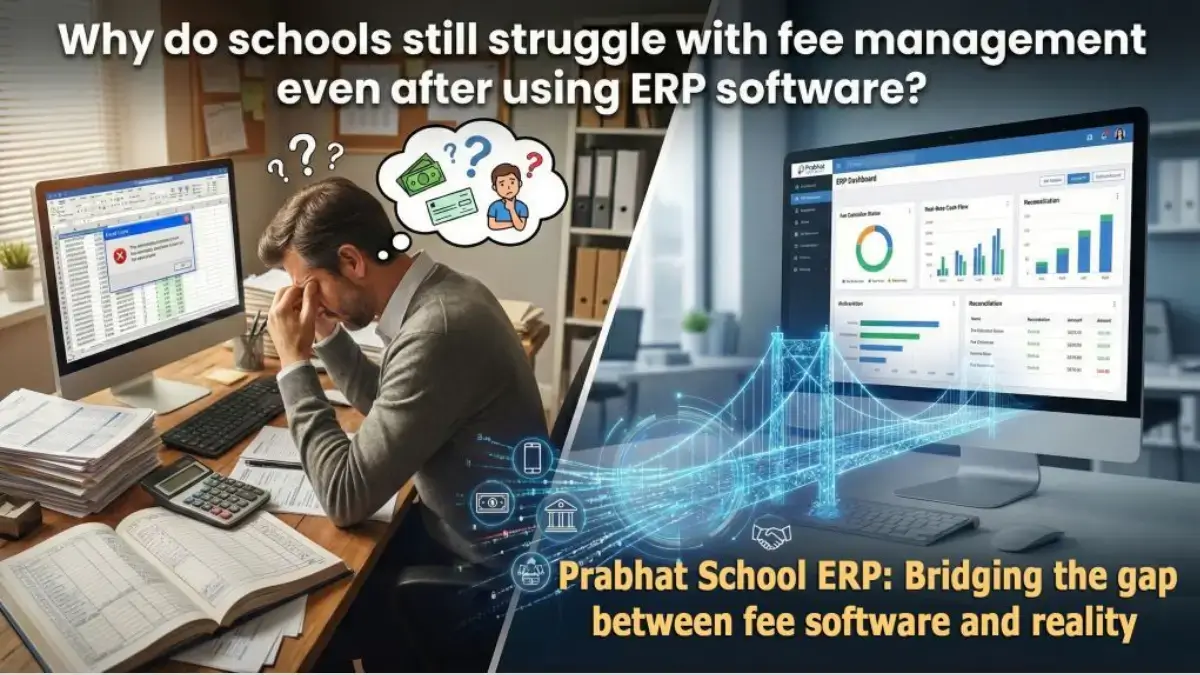
Why do schools still struggle with fee management even after using ERP software
Schools invest heavily in digital systems, yet many still ask why do schools still struggle with fee management even after using ERP software. On paper, ERP should simplify collections, reporting, and reconciliation. In reality, finance teams continue chasing payments, correcting mismatches, and maintaining parallel records.
The problem rarely lies in technology alone. It lives at the intersection of process gaps, unclear fee policies, parent communication issues, and partial system adoption. Until schools address these layers together, ERP remains underutilized.
Table of Contents
ToggleThis article breaks down the real reasons behind persistent fee management challenges, backed by practical examples, case studies, and finance-first insights from school operations.
Transport, hostel, lab, and activity fees often fall outside the main tuition structure. When these are not enforced through ERP logic, schools lose revenue silently.
Example:
- The student uses transport for two months before the records update
- School ERP does not auto-apply the transport fee
- Revenue loss goes unnoticed
The gap between fee software and real cash flow
School ERP dashboards look healthy, but bank balances tell another story
Many school ERPs show clean fee collection dashboards. Installments appear paid. Defaulters look limited. But when finance teams check the bank account, numbers don’t match expectations.
This disconnect occurs because ERP often tracks expected revenue, rather than confirmed cash inflow. Payment delays, partial payments, failed transactions, and offline collections distort the picture.
School ERP software records intent. Cash flow reflects reality.
Cash flow visibility matters more than reports
School expenses do not wait for reports. Salaries, utilities, vendor payments, and compliance costs demand real money, not projections.
When School ERP cannot answer basic questions like:
- How much cash is available today?
- Which payments cleared the bank?
- Which fees are pending confirmation?
Finance teams revert to manual tracking. This defeats the core purpose of adopting a School ERP.
Assumptions quietly replace enforceable rules
Many School ERPs operate on default assumptions:
- All students pay the same way
- Instalments follow fixed timelines
- Discounts apply uniformly
In reality, schools run on exceptions. Transport users change routes. Siblings receive concessions. Late joiners follow custom schedules. School ERP struggles when schools expect it to think instead of enforcing clearly defined rules.
Where fee problems actually start: process vs software
Software follows logic, not judgment
School ERP executes rules. It does not create them.
If fee policies remain undocumented, inconsistent, or verbally communicated, no software can manage them accurately. Schools often blame ERP when the underlying process lacks clarity.
For example:
- One department waives late fees informally
- Another enforces penalties strictly
- School ERP reflects neither correctly
The problem is not technology. It is governance.
Data quality determines ERP success
School ERP systems rely entirely on input accuracy. Yet many schools migrate incomplete or outdated data during implementation.
Common issues include:
- Duplicate student records
- Incorrect class mappings
- Old fee structures carried forward
- Missing concession approvals
Once incorrect data enters the system, every report becomes unreliable. Finance teams then cross-verify everything manually.
Parallel systems dilute automation
Schools often run ERP alongside:
- Excel sheets for reconciliation
- WhatsApp confirmations for payments
- Manual receipt books
- Separate accounting software
This hybrid approach breaks automation. School ERP becomes just another reporting tool instead of the single source of truth.
Common fee mismatches schools face daily
1. Fee collected but not reflected correctly
Parents pay through UPI, bank transfer, or cash. The payment reaches the school, but ERP updates lag or fail due to manual entry delays.
Result:
- Parent disputes
- Duplicate follow-ups
- Extra administrative workload
2. Partial payments cause confusion
ERP systems often expect full installment payments. When parents pay partial amounts, systems either reject the entry or misallocate it.
This leads to:
- Incorrect defaulter lists
- Unclear outstanding balances
- Parent dissatisfaction
3. Month-end reconciliation becomes manual
Despite using School ERP, many finance teams still reconcile bank statements manually because:
- Payment gateways are not integrated
- Offline payments are updated later
Transaction references mismatch
Common mismatches vs root causes
| Fee Issue | What ERP Shows | What Actually Happens | Root Cause |
|---|---|---|---|
| Paid installment | Fully paid | Partial payment | ERP not configured for split payments |
| Defaulter flagged | Overdue | Payment pending bank confirmation | No real-time bank sync |
| Excess balance | Advance fee | Duplicate entry | Manual correction outside ERP |
| Missing receipt | Unpaid | Cash collected | Delayed data entry |
Why parents care more about clarity than amount
Transparency builds trust, not discounts
Parents rarely object to fees when they understand them. Confusion arises when fee statements lack clarity.
Parents expect:
- Clear breakup of tuition, transport, and activities
- Visible concessions or scholarships
- Accurate outstanding balance
When School ERP generates vague or inconsistent statements, trust erodes quickly.
Payment flexibility improves collection rates
Parents now expect:
- UPI
- Debit and credit cards
- Net banking
- Instalment flexibility
Schools offering limited payment modes experience higher delays, not because parents cannot pay, but because payment feels inconvenient.
Communication matters as much as collection
Automated reminders, instant receipts, and payment confirmations reduce disputes dramatically.
School ERP systems that fail to communicate clearly push parents to call the office. Admin staff then handle avoidable queries manually.
Hidden revenue leakage, schools don’t track
Transport and optional services slip through cracks
Transport, hostel, lab, and activity fees often fall outside the main tuition structure. When these are not enforced through ERP logic, schools lose revenue silently.
Example:
- The student uses transport for two months before the records update
- School ERP does not auto-apply the transport fee
- Revenue loss goes unnoticed
Late fee penalties are rarely enforced consistently
Most schools define late fee penalties. Few enforce them systematically.
Reasons include:
- Manual calculation effort
- Fear of parent backlash
- School ERP is not configured for penalty logic
Over time, inconsistent enforcement trains parents to delay payments.
Discounts applied informally reduce visibility
When concessions get approved verbally or via messages, School ERP records show reduced fees without context. Management then cannot distinguish:
- Strategic discounts
- Policy concessions
- Untracked revenue loss
Why accountants still double-maintain records
Trust deficit in ERP numbers
Many accountants trust Excel more than School ERP. This habit comes from years of working around system limitations.
If School ERP reports do not match bank statements consistently, trust breaks. Once broken, teams maintain parallel systems.
Legacy habits resist change
Even after School ERP adoption, teams continue:
- Printing receipts
- Manually signing ledgers
- Updating Excel summaries
Change management often gets ignored during School ERP rollout.
Fee policy changes outpace system updates
Schools frequently revise fee structures mid-year. ERP settings lag behind real decisions.
Finance teams then:
- Adjust entries manually
- Keep notes outside the system
- Create reconciliation gaps
What smooth fee management really looks like
Single source of truth
School ERP should act as the only system for:
- Fee definition
- Collection tracking
- Reconciliation
- Reporting
No parallel spreadsheets. No shadow records.
Automation with oversight
Automation should reduce effort, not remove control. Finance teams need:
- Real-time dashboards
- Exception alerts
- Audit trails
School ERP must support decision-making, not obscure it.
How School ERP should support finance teams, not replace thinking
ERP enforces rules; humans design them
School ERP cannot compensate for unclear policies. Schools must first define:
- Fee schedules
- Concession rules
- Penalty conditions
- Refund policies
Only then can School ERP enforce them reliably.
Training drives adoption
School ERP training often focuses on clicks, not concepts. Finance teams need to understand:
- How fee logic works
- How exceptions get handled
- How reports derive numbers
Without understanding, trust never forms.
Custom workflows reflect real operations
Schools differ widely. School ERP must adapt to:
- Multiple campuses
- Different boards
- Varied fee cycles
Rigid systems force workarounds. Flexible School ERP supports reality.
Case studies from real school environments
Case Study 1: Mid-size CBSE school struggling with reconciliation
Problem:
ERP showed 95 percent fee collection, but bank balances lagged.
Cause:
The payment gateway was not integrated. Staff updated payments manually at day-end.
Solution:
After integrating payment channels and enabling real-time confirmation, reconciliation time dropped by 60 percent.
Outcome:
The finance team stopped maintaining Excel trackers.
Case Study 2: Urban school with high parent disputes
Problem:
Parents complained about incorrect outstanding balances.
Cause:
Partial payments were not supported properly in ERP.
Solution:
Fee rules were redefined to allow split payments and auto-adjust balances.
Outcome:
Parent queries dropped significantly within one term.
Case Study 3: Multi-branch school improving cash flow
Problem:
Late payments were common despite reminders.
Cause:
Late fee penalties were not automated.
Solution:
ERP logic was updated to apply penalties consistently with clear communication.
Outcome:
On-time payments increased from 65 percent to over 85 percent.
Poor vs smooth fee management
| Area | Poor Fee Management | Smooth Fee Management |
|---|---|---|
| Fee policy | Informal, inconsistent | Documented and enforced |
| Payment modes | Limited | Multiple digital options |
| Reconciliation | Manual | Automated with checks |
| Parent communication | Reactive | Proactive and clear |
| Reporting | Delayed | Real-time and trusted |
Why School ERP selection matters more than ERP branding
Many schools choose an ERP based on feature lists rather than aligning it with their finance workflow.
School ERP should:
- Match school fee complexity
- Support local payment behaviour
- Allow customization without hacks
- Provide audit-ready reports
This is where experienced providers like Prabhat Software focus on real school finance scenarios instead of generic modules.
FAQs
Q1. Why do schools still struggle with fee management even after using ERP software?
Ans: Because School ERP alone cannot fix unclear processes, inconsistent data, and manual workarounds.
Q2. Is ERP useful for school fee management?
Ans: Yes, when configured properly and used as the single source of truth.
Q3. What is the biggest cause of fee mismatches?
Ans: Lack of real-time payment integration and manual overrides.
Q4. How can schools improve fee transparency?
Ans: By offering clear digital statements and automated receipts
Q5. Why do finance teams still use Excel?
Ans: Due to trust issues with ERP data and habit persistence.
Q6. Can ERP help reduce late payments?
Ans: Yes, with automated reminders, penalties, and flexible payment options.
Q7. What should schools prioritize during ERP implementation?
Ans: Process clarity, data accuracy, and staff training.
Conclusion
The answer to why do schools still struggle with fee management even after using ERP software? lies beyond technology. School ERP does not fail schools. Misaligned processes, partial adoption, unclear policies, and poor communication do.
When schools treat School ERP as a finance partner rather than a reporting tool, fee management transforms. Clear rules, clean data, parent-friendly systems, and trained teams unlock real value. Providers like Prabhat School ERP focus on this reality, helping schools move from struggling systems to trusted financial clarity.
For result-driven growth, explore our Best School Management Software in India today!
Recent Posts

Categories

Author Bio
Mahesh Tiwari
Founder, SEO Expert & Software Developer at Prabhat Software
Mahesh Tiwari is an experienced SEO, AI-marketing, and software development specialist helping brands adopt the latest digital marketing and technology trends to achieve sustainable online growth.